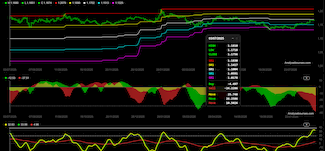
How Does Our Automated Trading System Using the Parabolic SAR Work?
The Parabolic SAR is effective at managing erratic price movements when the underlying trend weakens. One day ahead, our technical indicator helps you better anticipate upcoming market movements. At Analysebourses.com, we have optimized this tool within a 100% automated trading system.
Our approach stands out by using only continuous closing-price curves, without Japanese candlesticks. This clean visual method helps eliminate intraday market noise and focuses solely on the underlying price dynamics. The automated system executes trades without emotional bias, based on strict mathematical levels.
One-Day-Ahead Projection
The key strength of our algorithm lies in calculating the Parabolic SAR one day in advance. This Parabolic SAR projection makes it possible to anticipate reversal levels before the markets even open.
Specifically, when the closing-price curve crosses the projected Parabolic SAR trajectory, the system identifies a trend reversal. It then immediately closes the current position and opens a new one in the opposite direction.
Filtering with ADX, ADXR and Volatility
One of the classic weaknesses of the Parabolic SAR and trend-following indicators is the generation of false signals during sideways market conditions (ranges). To address this issue, our automated system does not rely blindly on price action, but filters each move using trend-strength indicators:
- Trend strength (ADX / ADXR): The system ignores reversal signals when the ADX indicates a lack of directional strength. Conversely, when a trend is well established, the indicator becomes the primary tool for managing the position.
Key Features of Our Algorithmic Strategy
- Clean analysis: Use of a simple closing-price curve to reduce visual noise.
- Anticipation: Reversal levels are calculated one trading session in advance.
- Strict discipline: Automated execution for systematic risk management.
- Triple validation: The system automatically generates an exit signal for the current position and a reversal signal in the opposite direction. Signals are confirmed simultaneously by price, historical volatility, and directional strength (ADX/ADXR).